Friday, March 18, 2011

1996 College Basketball

1. Tony Delk: Was the Most Outstanding Player of the Final Four. He set a championship game record with seven three-pointers and scored 24 points and had seven rebounds.

He was the MVP of the Midwest regional. He scored 22 points vs. San Jose St. in round one and added 25 more against #9 Wake Forest in the regional final, which included 4-5 threes.

Delk was named first team All-American by most major publications and was also the SEC Player of the Year.

He led the Wildcats with 17.9 points per game while shooting 44.3% on threes and 49.4% from the field. He also averaged nearly two steals per contest.

Kentucky went 34-2 and 16-0 in the SEC and finished #2 in the final polls. They would beat four of the top 15 teams in the final AP poll on their way to the national title.

Big Blue took out #12 Utah by 31, #9 Wake by 20 to get to the Final Four. They would avenge an earlier loss by knocking out #1 UMass 81-74 as Delk scored 20.

In the title game Kentucky held off #15 Syracuse 76-67.


2. Tim Duncan: Was first team All-American, and the ACC Player of the Year.

He was named ACC Tournament MVP after a 27 point 22 rebound effort over top seed Georgia Tech. He set tournament records for most rebounds in a final (22) and tournament (56).

He became the first player in ACC history to lead the league in scoring (19.1), rebounding (12.3), blocks (3.8), and field goal % (55.5).

Duncan had two double-doubles to start NCAA play. He put in 27-13 in the sweet 16 win over Louisville, despite coming up with the flu.

In the regional final loss to Kentucky Duncan finished with 14-16-6 in 39 minutes.

Wake Forest finished 26-6 and #9 in the polls. Duncan helped them to the 7th best defense in the country (61.3 PPG).


3. John Wallace: He was named to the NCAA All-Tournament team, All-West Regional team and was a consensus 2nd team All American.

He was named to the first team All Big East regular season and tournament teams.

Wallace averaged 22.2 points, 8.7 rebounds, and 2.4 assist per game. He scored over 30 fives during the season.

He shined during the NCAA tournament with several memorable performances. He had 18 points in each of Syracuse’s early wins over Montana St. and Drexel.

In the sweet 16 against Georgia he had 30-15. It was his pass that set up Jason Cipolla’s tying jumper to force overtime. He then scored the go ahead bucket with less than three seconds in the extra session of Syracuse’s 83-81 win.

He had a game high 21 in the Final Four win over #19 Mississippi St. as he played all 40 minutes.

In the final against #2 Kentucky, Wallace carried the Orangemen with 29 of their 67 points and added 10 rebounds. Syracuse would get to within four points late in the second half until Wallace fouled out.

Syracuse got to their first Final Four in nine years after knocking out #4 Kansas 60-57. They finished 29-9, 12-6 in the Big East and #15 in the final polls.

Wednesday, March 2, 2011

NFL 1995

1. Brett Favre: Was the NFL MVP, Offensive Player of the Year and unanimous first team All- Pro. He was also the starter for the NFC Pro Bowl team (7-14 114 yards TD).

He led the NFL in passing yards with 4413 and TDs with 38 (3rd most in a season).

Favre was 2nd in league completions (359), rating (99.5), yds /attempt (7.7), and 6th in comp. % (63.0).

In his final seven games he threw for 21 TDs vs. just 2 Ints as Green Bay went 6-1. He amassed 300+ yards four of those games and over 122.0 QB rating five times.

In the Wildcard round against Atlanta, Favre was 24-35 199 yards and 3 TDs (111.5 rating) as the Packers hammered the Falcons 37-20.

He led Green Bay’s stunning upset of the defending champion 49ers 27-17 in San Francisco. He threw for 299 yards and two scores on 21-28 passing. His two first half TD tosses gave the Packers a 21-0 lead.

He helped Green Bay to a 4th quarter lead on the road at much favored Dallas in the NFC title game. Favre threw for 307 more yards and 3 TDs. His one-yard scoring pass to Robert Brooks put the Packers in front in the 3rd quarter.

Green Bay would eventually lose to Dallas 38-27. The Pack went 11-5 and won their first division title since 1972, and advanced to the NFC title game for the first time since Vince Lombardi coached.


2. Emmitt Smith: Set the NFL record with his 25 touchdowns. He was runner up for the MVP, unanimous All-Pro and NFC Pro Bowler.

He led the league in carries (377), yard (1,773), points (150), and yards from scrimmage (2,148).He was 4th in yards/carry (4.7).

He added 62 catches (2nd on team) for 375 yards.

Emmitt had 11 100 yard games including four with at least 150.

He was the first and only player in NFL historywith five straight 1.400 yard seasons rushing.

His best game came on Monday Night in Week 1 at New York. Smith ran 60 yards for a touchdown on the game’s third play. He went on to score three more times and run for 163 on just 21 carries.

In the Divisional round win over the Eagles, Smith had 99 yards rushing, 40 receiving and one-yard TD run.

He put Dallas into their third Super Bowl in four years with his performance in the NFC Championship. He gave the Cowboys the lead in the 2nd quarter with a short TD run, right before halftime.

In the decisive 4th quarter, he scored the go-ahead and clinching TD. Smith finished the day with 150 yards on 35 carries.

He added two more short TD runs in the Super Bowl, including a four yarder to ice the Cowboys title.

Dallas won their 3rd Super Bowl in four years. They hammered Philadelphia 30-11 and came from behind to beat Green Bay 38-27 to get to advance to Super Sunday. They beat Pittsburgh 27-17 in the Big Game.

The Cowboys went 12-4, won the NFC East and had the top record in the NFC. They finished 3rd in the NFL with 27.2 Points per game.


3. Jerry Rice: Was a unanimous All-Pro and Pro Bowler. He set an NFL record with 1848 yard receiving (still stand today.)


His 122 catches were just one short of Herman Moore’s record of 123 in 1994. He averaged over 15 yard per reception.

He also was third in the NFL with 15 receiving touchdowns. He was tied for second with 17 total TDs. His 1884 yards from scrimmage were 3rd in the NFL.

In the 1995 season Rice became the leading receiver in yards and catches for a career in NFL history.

Against the 8-1 Cowboys, helped lead the 5-4 49ers resurgence with 5 catches 161 yards and an 81-yard TD bolt.

He had a career day against Minnesota on Monday Night Football with 14 grabs, a career high and MNF high 289 yards and 3 TDs (all n the first half).

In the playoff loss to Green Bay, Rice had 11 catches (tied playoff high) for 117 yards.

San Fransisco went 11-5 and won the NFC West as well as a 1st round bye. They topped the NFL with 28.6 points per game.

Thursday, February 10, 2011

College Football 1995

1. Tommie Frazier: Was the MVP of the Fiesta Bowl (National Championship) and runner up in the Heisman voting.


He was a consensus All-American, Sporting News Offensive Player of the Year, Big Eight Player of the Year, and won the Unitas award (top senior QB).

He was also named by Sports Illustrated as the nation’s top offensive player.

He passed for 1,362 yards and 17 TDs and ran for 604 yards and 14 TDs.

Against # 7 Kansas St. Frazier threw for 4 TDs. The following week, against #5 Colorado he threw for 241 yards and 2 TDs and ran for another score.

In the National Championship game vs. #2 Florida, he had one of the decade’s iconic runs; 75 yards for a touchdown.

He finished the game with 199 yards rushing on 16 carries and 2 TDs and 105 yards and a score through the air.

Nebraska went on to take their second straight national championship in a rout 62-24 over Florida.

They beat four top 10 teams (KSU, Kansas, Colorado and Florida) by an average score of 49-18. The Cornhuskers went 12-0 and easily won the Big Eight in its final season. They scored a NCAA high 52.4 points per game and had average nearly 400 yards rushing per game (399.8).

2 Eddie George: Won the Heisman Trophy and was a unanimous All-American. He won the Camp, and Maxwell awards (Top player), Doak Walker (top RB), and Big 10 Offensive POY.

He led the NCAA with 24 TDs and 144 points (12.0 per game).

His top performance came against Illinois

and the Illni defense that featured future top five picks Simeon Rice and Kevin Hardy. He rumbled for a school record 314 yards (8.9 per rush) and three total TDs.


George ran for 205 yards and 2 scores in the Buckeyes 45-26 win over #11 Notre Dame.

He had 89 yards and a TD in Ohio State’s 20-14 loss to #4 Tennessee in the Citrus Bowl.

The Buckeyes finished the season 11-2. They won their first 11 games, including over #11 ND, #13 Penn St, and #25 Iowa. They finished #6 in the final poll after a loss to Tennessee.

3. Keyshawn Johnson: Was the Rose Bowl MVP. He was a consensus All-American, Pac 10 Offensive POY, and 7th in the Heisman.

He was 4th in the country with 90 catches and had 1218 yards and six TDs.

In the Rose Bowl, Keyshawn set a record with 216 yards. He had 12 catches and scored a TD, as USC upset #8 Northwestern.

He also had the game winning TD in a 31-30 win over Stanford.


USC finished the season 9-2-1 and Pac-10 champions (6-1-1) and beat Northwestern 41-32 in Pasadena. The Trojans were #12 in the final poll.

Saturday, January 29, 2011

MLB 1995

1. Greg Maddux: Won his 4th straight NL Cy Young award. He was a unanimous choice. He finished 3rd in the NL MVP voting.


He earned the Gold Glove, Pitcher of the Year awards by AP, Sporting News and Baseall Digest. He was the NL Pitcher of the Month in July and September.


He led the league in wins (19), winning percentage (.905) after losing just twice. He was the leader with a 1.63 ERA (3rd lowest since 1968), 10 complete games, 3 shutouts, 209.2 IP and .81 WHIP.


He was an NL All-Star team.


Maddux went an amazing 51 IP without allowing a walk.


In the playoffs, the “mad dog” won the clinching Game Four over Colorado going seven while striking out seven.


In the NLCS sweep of Cincinnati, Maddux went eight innings giving up just one earned run to pick up the win in Game Three.


In the World Series opener, Maddux outdueled Orel Hersheiser and the high powered Indians. He allowed just two hits and two unearned runs en route to a complete game 3-2 Braves win.


Atlanta upset Cleveland in six games to win the World Series. The Braves went 90-54 (144 games due to the strike) and won the NL East.


2. Albert Belle: Was Sporting News and Baseball Digest Player of the Year in MLB. He finished 2nd in the AL MVP voting. He was also the starting LF for the AL All-Stars and a Silver Slugger.


He led the league in Home Runs (50), RBIs (126),doubles (52), total bases (377), runs (121), slugging (.690) and was second in OPS (1.091). He also hit .317 which was good for 8th in the AL.


He was the player of the month in the AL in August and September.


Belle was the first major leaguer with 50 HR and 50 doubles in the same season.

The Indians left fielder finished with a vengeance 18 HR in the final 29 games.


In Game 1 of the ALDS Belle pull Cleveland even with Boston twice, including a two-run double in the sixth off Roger Clemens and a solo HR in the eleventh. Cleveland would go onto win 5-4 in 13.


In Game 5 of the World Series he helped Cleveland force a Game Six with a two-run bomb in the first inning off Greg Maddux, and scored thego-ahead run in the sixth following and intentional walk.


For the postseason Belle homered four times and drove in eight runs and scored eight times in 14 games.


The Indians won a ML best 100 games and were an incredible 30 games in front of second place Kansas City in the Central Division. They swept Boston in the ALDS and beat Seattle in six in the ALCS before falling to Atlanta in the World Series in six games.

Cleveland led baseball with 840 runs scored and a .291 team batting average.

3. Randy Johnson: Won the AL Cy Young. He was the Sporting News AL Pitcher of the Year, starter of the AL All-Star team, and 6th in the MVP.

The Big Unit led the AL in ERA (2.48) and was 18-2 (tops in winning percentage), and his 294 strikeout were best in the league.

He also had six CGs and 3 SHOs.

Johnson dominated down the stretch including a 7-0 mark in his final ten games as Seattle erased a 13 game division deficit to California.

In the one game playoff win over the Angels Johnson stuck out 13 and just gave up three hits and one run in a complete game.

In the ALDS Seattle held off elimination when Johnson went seven and struck out ten in their 7-4 win.

With one day rest Johnson came on in relief and rescued the Mariners in Game Five. He pitched a scoreless ninth and tenth (allowed one run in the top of the 11th). He struck out six in those three innings and got the win as Seattle scored twice in the bottom of the 11th to advance to the ALCS.

In the ALCS Game 3 he gave the Mariners a 2-1 series lead with 8 IP 6 K’s 4 H and 1 ER as Seattle won 5-2 in 11.

He finished the postseason with a 2.48 ERA and 29 K’s in 25.1 IP.

Seattle went 79-66, and won the AL West. They beat New York in five to get to their first ALCS, which they fell to Cleveland in six games.

Wednesday, January 12, 2011

NBA 1995

1. Hakeem Olajuwon: Was the Finals MVP. He put up 32.8 PPG, 11.5 rebs, and 5.5 ast. In the four game sweep of the Magic. Hakeem had a league high 33.8 PPG in the playoffs, and added 10.3 rebs,
4.5 asts, and 2.8 blk, while shooting 53% in 22 postseason games.

He was an All-Star, 3rd team All-NBA and 2nd team All-Defense and fifth in the MVP voting.

The Dream was 2nd in the NBA in scoring with 27.8 points, and blocks with 3.4. He pulled down 10.8 boards per game in the regular season and shot 51%.

He was the first player to finish in the top 10 in the league in blocks and steals in the same season.

He posted 35 PPG in round one vs Utah, including 40 and 33 in games four and five to clinch the series.

Olajuwon averaged 30-11.6-5.7 in the final three games in round 2, as he led Houston back from down 3-1 to stun Phoenix in seven.


With the famous use of the “dream shake.” Hakeem powered the Rockets past MVP David Robinson and Spurs with 41-16 in a Game Two win, 42-9-8 in Game Five and 39-17 and five blocks to clinch the West in Game Six.


The Rockets were 47-35 in the regular season. They beat the top three seeds in the West (San Antonio, Phoenix, Utah) on their way to the Finals.They pummeled the East’s top seed Orlando towin their second straight NBA crown.

2. Shaquille O’Neal: Won the scoring title and was MVP runner-up. He was 2nd team All-NBA., and starting center for the East All-Stars (22 points and 7 rebounds). He was also the NBA Player of the month in November.


Shaq averaged 29.3 point game and also led the league in field goals. He was second in FG % (58.3), and 3rd in rebounds (11.4).


In Round two against Chicago, O’Neal put the Magic on his back with 23-22 and five blocks in Game Five and 27-14 in the clincher in Game Six.


In the East Finals he dominated Indiana with 39 and 10 in Game Two.


In Game Five to break a 2-2 series tie, he had 35-13 in the Magic 108-106 win.


He averaged 28-12.5 and 2.4 blocks in the Finals loss to Houston.


Orlando had the top record in the East (57-25). They beat Boston in four, Chicago in six and Indiana in seven to get to their first Finals, where they were swept. The Magic led the NBA in scoring with 110.9 points per game.


3. David Robinson: Won the 1995 MVP. He was first team All-NBA and All-Defense.


He was third in the league with 27.4 points and 4th with 3.2 blocks and field goals with 788. He led the league with 656 free throws.

He added 10.4 boards per game and hit on 53% of his shots and nearly three assist per contest


In the playoffs Robinson averaged 25.2 ppg and 12.1 rebs. In the second round against the Lakers he put up 28-16 and 3.8 blocks in the Spurs four wins.


The Spurs had the top record in the NBA (62-20). They swept Denver in the first round and beat the Lakers in six in the second. They were beat in six games by Houston.

Tuesday, November 23, 2010

Colege Basketball 1995

1.Ed O’Bannon: Was the Most Outstanding Player in the Final Four. He posted game highs with 30 points and 17 rebounds in the Final win over #6 Arkansas. He added three assists and three steals in all 40 minutes of action.

He added 15 points In the Bruins semifinal win over Oklahoma St.

He scored 24 in UCLA’s 2nd round thrilling win over Missouri. He averaged over 19 a game in the NCAAs.

In the regular season O’Bannon was one of the nation top players and was award Player of the Year by the U.S Basketball Writers and the Wooden award and was a consensus All-American.

He was the co-Pac-10 player of the year.

Ed averaged 20.8 points, 8.3 rebounds, 1.9 steals (team high), 53% fgs and 43% 3FG (55-127).

He put up 27.8 points and nine rebounds per game in a five game, end of the season stretch including wins over #15 Arizona, and #16 Arizona St.

UCLA finished the season on a 19 game winning streak. In the non conference UCLA beat #2 Kentucky. They finished 32-1 and 17-1 in the Pac-10 and earned the #1 seed in the West and finished on top of the AP poll.

In the NCAA tournament, they handled #18 Mississippi St. in the sweet 16, escaped #8 UConn 102-96 to get to the Final Four. They beat #14 Oklahoma St. 74-61 and Arkansas 89-78 to win the title.

The Bruins averaged over 87 points per game, good for 8th in the country.


2. Corliss Williamson: Was the NCAA tournament’s leading scorer with 125 points scored.

He was named All-Final Four, and was the Midwest region MVP

In the sweet 16 vs Memphis St. Big Nasty poured in 27 and 13 in Arkansas’ 96 91 overtime victory.

Wiliamson helped the Hogs get back to the Final Four with 21 points, eight reb. and three ast in a hard fought 68-61 win the regional final over #13 Virginia.

In the Final Four vs. #4 North Carolina Williamson had 19 of his 21 points in the second half to propel Arkansas to the title game 75-68.

He was the SEC Player of the Year for the second straight year, and consensus 2nd team All-Ameican, as well as All-SEC tournament.

He put up 19.7 points, 7.5 rebs., and shot 55% from the field.

Arkansas finished #6 in the final poll and a #2 seed in the NCAAs. They finished the season 32-7 and 12-4 in the SEC (West champions) and lost to #2 Kentucky (95-93, OT) in the SEC title game. They lost to #1 UCLA in the national title game.


3. Jerry Stackhouse: Was named Player of the Year by Sports Illustrated and considered one of the top all around players in the country by his peers.

He was the Southeast region MVP, and capped that performance of with 18 points 12 rebounds and six assists in a 74-61 regional final win over top seed Kentucky.

He had 18 points in the Final Four loss to Arkansas.

He was a consensus All-American and All-ACC.

Stackhouse led the Tar Heels with 19.2 points, 8.2 rebounds and 50 steals. He chipped in with 2.7 ast per contest and 51% FGs, including 41% on 3s.

His most memorable play was this dunk in UNC’s double overtime win over rival Duke.

North Carolina was co-regular season ACC champion at 12-4 and 28-6 overall. The Tar Heels were a season low #4 in the final polls and were #1 six weeks. They advanced to the final four and lost to #6 Arkansas, after defeating #2 Kentucky and #22 Georgetown in the regionals.

Thursday, September 9, 2010

1994 NFL

1. Steve Young: Was the consensus MVP in the regular season and the Super Bowl MVP.

He set an NFL record with 112.8 passer rating. He had the fifth most TD passes in a season (35, first in the league). He had the 2nd highest completion % in history (70.3).

He was consensus All-Pro and a Pro Bowler.

Young also led the league in yards/att (8.6). He passed for 3969 yards (4th in NFL) and just 10 Ints.

He finished 8th in the NFL with seven rushing touchdowns.

In San Francisco’s 44-15 rout of Chicago in the divisional round, Young threw and ran in a touchdown.

In the NFC Championship game against Dallas, Young threw two more TDs and ran in another score in the Niners 38-28 win, including a 28-yard strike to Jerry Rice at the end of the half to put San Fran up 31-14.

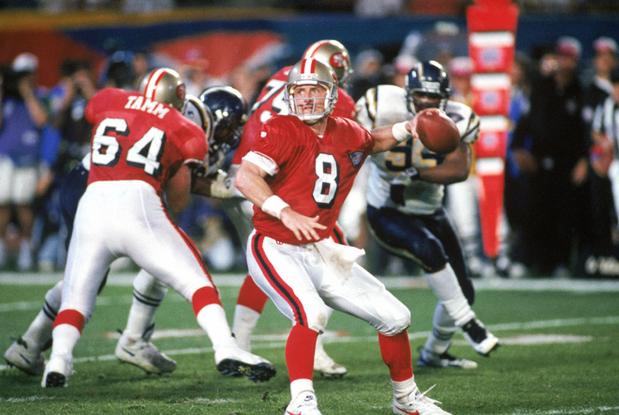
Young light up San Diego in the Super Bowl, on his way to record setting performance. He was 24-36 for 325 yards and a record 6 TDs. He also had a team high 49 yards rushing on just five carries.

He threw two TDs in the first five minutes of the contest. After the Chargers cut the lead to seven, Young hit William Floyd and Ricky Watters for two more scores to push to lead to 21.

The 49ers went 13-3, including 10 straight wins (13-2 before Young sat out part of final game) and won the NFC West. They beat Chicago 44-15 in round two. They avenged two championship game losses to Dallas by taking down the Cowboys 38-28.

They pounded San Diego 49-26 in Super Bowl XXIX in Miami. The Niners set a NFL record with 505 points (31.6 per game) while allowing just 18.6 per game.


2. Deion Sanders: Was the NFL Defensive Player of the Year. He was a consensus All-Pro and Pro Bowler.

He had six interceptions and returned 3 touchdowns (tied for most since 1972) and returned for 303 yards (2nd most in NFL history) in just 14 games.

He had 74 yd TD vs New Orleans, 93 yd TD vs Atlanta, and 90 yd TD vs San Diego. He had a Int in their key win over then 8-1 Dallas.

In NFC Championship against Dallas, he helped shutdown Michael Irvin and also intercepted Troy Aikman. He also had a 25 yard kickoff return.

He had another interception in the Super Bowl. This was second of his three straight playoff games with an interception, an NFL record.

He also had an Int. in the Pro Bowl.

He led a 49ers defense that was sixth in scoring defense and tops in interceptions.

Deion became one of the most popular athletes of his era in his only season in San Francisco.


3. Dan Marino: Was 1st team All-AFC named by Pro Football Weekly and UPI and was 2nd team All-NFL by AP. He was also a Pro Bowler.

He was named NFL Comeback Player of the Year after tearing his achilles in 1993.

Marino was second in the league in yards (4453) and completions (385, 3rd most ever). He third in TDs (30), and passer rating (89.2).

Marino led Miami on four 4th quarter game winning drives. They included week one vs. New England, where he threw for 473 and 5 scores including the winning TD.

In week 13 vs. the Jets, Marino led the Dolphins from down 24-6 to New York in the second half to a stunning 28-24 W. He was 31-44 for 359 yards and four second half TDs (all to Mark Ingram Sr.) including the famous “fake spike”.

In the Wildcard win over the Chiefs, Marino torched KC (22-29, 257 yards and 2 TD) and sent Joe Montana home in his final game.

Against San Diego Marino put Miami in position to go to the AFC Championship with a 262 yard, 3 TD performance. His last second drive put Miami in position for the game-winning FG, that was missed.

Miami was 10-6, won the AFC East and was third in the league in scoring (24.3 per game). In the playoffs, they defeated Kansas City 27-17 but fell at San Diego 22-21.