Friday, May 18, 2012

1998 College Football

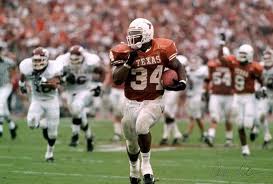
1. Ricky Williams: Won the Heisman Trophy. He set the NCAA career record for rushing yards, touchdowns, points and 200 yard games.

He was a consensus All-American and Doak Walker (Best RB) for the second straight year. He was also the unanimous national player of the year.

The Texas Tornado totaled 2,124 yards (6.0 ypc) and 27 TDs in 11 games.  He added 262 yards and TD receiving.

In his record breaking performance he carried the ball 44 times for 259 yards as Texas upset #11 Texas A&M. He eclipsed Tony Dorsett’s mark on a 60 yard epic dash.


He ran for over 200 yards six times, including two 300 yard games.

Williams earned MVP of the Cotton Bowl, a 38-11  route of SEC West Champion Mississippi St. He ran for 203 more yards and 2 TDs.

The Longhorns were 9-3 and 6-2 in the Big 12. They finished #15 in the polls.


2. Peerless Price: Was the MVP of the Fiesta Bowl (national championship game). He had four catches for 199 yards and the game changing 79 yard TD.

Price’s 4th quarter TD (the longest play in Fiesta Bowl history) gave Tennessee a 21-9 cushion over Florida State.

He was also named the SEC title game MVP with six receptions for 99 yards and a TD. He hauled in a 41 yard score to give the Vols a 17-14 lead in the 4th.

In Tennessee’s season opener against #25 Syracuse, Price helped UT to a 33-31 comeback win with 87 yards and 2 TDs.

He made clutch plays all season including a key TD catch in a 20-17 OT win over #5 Florida and a 100 yards Kick return TD vs. Alabama.


Tennessee won the national title over #2 Florida St. 23-16 to capture their first national championship since 1951. Rocky Top was 13-0 and won the SEC for the second straight season.


3. Champ Bailey: He was the national defensive player of the year (Bednairk award). He was a consensus All-American.

He also finished 7th in the Heisman voting and a finalist for the Thorpe award as the top defensive back in the country.
Champ was a three-way threat with 3 INTs, 745 yards receiving (6th in the sec) 5 TDs, and a 21.8 average on kick returns.

Bailey was on the field for over 100 plays in six games..

He was the Peach Bowl MVP with 3 rec. for 74 yards and 14 yard TD, 2 tackles 1 pass break up and 5 KO returns for 102 yards in a 35-33 win over #18 Virginia.

Georgia was 9-3, including 6-2 in the SEC and finished #14 in the poll.

Saturday, May 5, 2012

NBA 1998


1. Michael Jordan: Won his 5th MVP and 6th Finals MVP.

He was an unanimous all-league selection.  He was first team All-Defense. He was a starter on the East All-Star team and was MVP with 23 points and eight assists.

He was the NBA Player of the month in December and March.

At age 35 Jordan played in all 82 games. He lead the league in fgs, fgs attempted and scoring (28.7) for the tenth time in his career (a NBA record). He was second in NBA in free throws.


He had 41 points in a Game Two win and 28-9-8 in the grueling Game Seven victory.
 
In the Finals vs. Utah cemented his legacy. He scored 37 in Game Two to tie the series at one.

He played perhaps the greatest game in NBA history in Game Six to secure a sixth title.

MJ scored 45 points and his three play sequence to end the game gave Chicago the championship.

Chicago won 62 games while just allowing 89.2 points per game, good for 3rd in the league. They beat New Jersey and Charlotte in three and five games to advance in playoffs.


2. Karl Malone: Was the MVP runner up and made 1st team All-NBA for the 10th straight season.

He was first team All-Defense and the Player of the Month in February.

He was third in league in scoring (27) and 6th in rebounding (10.3). He led the league in free throws and was second in field goals. He was ninth in FG% at 53%.


He was a starter for the West All-Star team.

The Mailman helped close out Houston with 29-13 and 31-14 in Games Four and Five.

Against San Antonio in Game Four he had 34-12.

In the Western Conference Finals sweep vs. LA he averaged 30 points 10 rebounds and 4.5 assists per game.

Perhaps, he had the best game as a pro with a 39 point effort on a 17-27 shooting night along with nine rebs and five asts to help stave off elimination in Game Five of the finals vs. Chicago.

The Jazz reached the Finals for the second straight years and lost to Chicago in both years in six games. They beat the Rockets and Spurs in five and swept the Lakers. They were third in scoring with 101 PPG.

Utah tied Chicago with the best record in the league by winning 62 games.

3.  Shaquille O’Neal:  Was first team All-NBA and 4th in MVP voting.

He was the Player of the Month in January and April.

O’Neal lead the NBA in fg% and fta, 2nd in scoring and 8th in blocks.

He was an All-Star and scored 12 points.

He averaged 28.3 ppg, 11.4 rpg 2.4 bpg 58.4% in the regular season.


The Lakers were 46-14 with Shaq in the line up.

In Game Four against Portland, the series clincher, O’Neal had 31 pts on 13-17 fgs 15 rebounds five assists and four blocks


Shaq averaged 36 ppg in final three games of West Finals loss to Utah.

L.A advanced to the West Finals for the first time in seven seasons. They were 61-21 and tied for the Pacific division title with Seattle. They won seven of nine games in the first two rounds of the playoffs.


Monday, April 9, 2012

1998 MLB


1. David Wells: Threw a perfect game in May and was the ALCS MVP.

He became the first player since 1994 to throw a perfect game when beating the Twins.

Within the regular season he had the top winning percentage .818 after a 18-4 record.

He also led the league with five shutouts and a 1.04 WHIP.

He was 2nd in the AL with eight complete games and 5th with a 3.49 ERA.

He was 4-0 in the playoffs and won Game One of each Series the Yankees won.

Boomer Wells struck out nine in eight innings to open the ALDS for New York in a 2-0 win over Texas.


Wells also picked up the win in Game One of the Fall Classic.

The Yankees set a American League record with 114 wins. They also set a record with 125 wins including the postseason.

They swept Texas outscoring the Rangers 9-1 in three games. New York beat the reigning AL champs Cleveland in six games and swept past San Diego in the Fall Classic. The Yanks had the top ERA in the AL at 3.82.

2. Kevin Brown: Was named the National League Pitcher of the Year by the Sporting News. He was the Baseball Digest Pitcher of the Year.

He was also named 1st team starting  pitcher by Baseball America.

He was an All-Star and finished 3rd in the NL Cy Young voting.

During the regular season Brown finished 2nd in the NL in ERA (2.39), strikeouts (257), and WHIP (1.07).

He was 18-7 and had seven complete games.

KB set the division series record that still stands with 16 strikeouts in Game One vs. Houston, a 2-1 win for San Diego.

He helped the Padres take Game Three allowing just one earned run in 6 and 2/3 innings.

In Game Two of the NLCS the Padres’ ace shutout Atlanta with eleven strikeouts as San Diego built a 2-0 series lead.

In two games of the World Series, Brown strikeout 13 Yankees in 14 1/3 innings.

San Diego advanced to their first World Series in 14 years after stunning the 106 win Braves in six games. They knocked out Houston in four games. The Padres won 98 games and the NL West by 9.5 games.

3. Nomar Garciaparra: Was the AL MVP runner-up.

He was one of the top hitters in the American League. He finished 5th in hits (195), 6th in batting (.323), and 7th in RBI (122).

He was in top 10 in total bases, slugging, runs, triples and home runs with 35.

It was his 2 HR and 4 run performance that helped clinch the Red Sox the Wildcard.

He was also the AL Player of Week twice.


He drove in four including 3 run HR to put Boston up 6-0 in 5th of ALDS Game One win.

In the 4th inning of Game Four, his HR gave the Sox a 1-0 lead they would hold until 8th when David Justice put Cleveland ahead for good in the series clincher.


Boston won 92 games, the second most in the AL and won the Wild Card. They were third in the AL in scoring and batting average.


Sunday, February 5, 2012

1998 College Basketball


1.       Antwan Jamison: Was the consensus national player of year.  He also a consensus All-American.

He earned numerous awards in the ACC including Player of Year, a record setting seven times Player of the Week. He was also named the ACC Male Athlete of the Year.

He led the conference in scoring (22.2) and rebounding (10.4). He also led the ACC in field goals (316) and free throws (184). Jamison was 2nd in the league shooting 57.9% from the field.

In a #1 vs. #2 match up, North Carolina soared past the top ranked Blue Devils of Duke behind 35 points and 11 rebounds from Jamison.

The Tar Heels' star forward put up 36-16 vs. #20 Maryland in an 85-67 win to avenge a previous loss to the Terrapins.

Jamison earned ACC tournament MVP with a 22-18 performance in the Final win over #3 Duke.

In the NCAA tournament he 20 points and 14 boards in a Sweet 16 victory over #16 Michigan St.

He followed that up with a 20 point effort in a 75-64 regional final win over #6 UConn. Jamison would be named the MVP of the East Region.

North Carolina would fall to #7 Utah 65-59 in the Final Four.

The Tar Heels would return to the Final Four for the second straight year.

They won the ACC tournament and finished the season ranked #1 in the polls. UNC was 34-4, #1 seed in the East in the NCAA tournament and averaged almost 82 points per game.


2.       Raef LaFrenz: Was a consensus All-American for the second straight year and was second in the Player of the Year voting (Wooden award).

He was the 3rd player in the 1990s to be a consensus All-American twice, joining Shaquille O’Neal and Tim Duncan.

He was also named Big 12 Player of the Year for the second straight season and All-Big 12 for a third time.

He posted 19 double doubles including seven straight.

LaFrentz was 5th in the Big 12 in scoring (19.8), 3rd in FGs (232), and 8th in blocks (1.5).

He led the league in rebound and was 14th nationally averaging 11.4 boards per game.

The senior’s top performance came against the defending champions Arizona. He scored a career high 32 points on 12-17 shooting and all eight free throws.

In the NCAA tourney he averaged 21 ppg, 14.5 rpg and shot 74% in two games.
The top seed Kansas was upset by Rhode Island in the second round.

Kansas won the Big 12 regular and tournament crowns. They were 35-4 and #2 in the final poll. The Jayhawks went 15-1 in league play including 12-0 with LaFrentz in the lineup.

3.       Andre Miller:  Was the West Regional MVP. He was All-Final Four.

He put up the fourth triple double (18-14-13) in NCAA history as Utah routed the defending national champions Arizona 76-51 in the regional final.

He was 1st team All-WAC, 3rd team All-American by the U.S Basketball Writers, and honorable mention by the AP.

Miller averaged 14.2 points and 5.2 rebounds per game in 34 games.

He was 5th in the WAC  in shooting at 54.9%, 4th in steals (2.15), and 6th in ast. (5.2).

In six NCAA tournament games, he averaged 16.7 ppg, 7.5 rpg, 6.8 apg, and two steals.

In the 2nd round against #17 Arkansas he had 28 points on 9-14 shooting. He added seven rebounds and six assists.

He was the catalyst to another upset in the Final Four over #1 North Carolina with 16-14-7.

Miller guided the Utes to a 41-31 lead in the National Championship at the half. Utah would eventually fall to #5 Kentucky 78-69 in the title game despite 16-6-5 from Miller.

In the summer, Miller won gold with at the Goodwill Games playing with top returning college players against international senior national teams. He led the U.S squad in assists and was third in scoring.

Utah finished the season #7 in the polls and was the WAC regular season champions. They were 30-4.

Wednesday, January 4, 2012

NFL 1997


1.       Terrell Davis: Was the Super Bowl MVP of SB XXXII. He ran for the 2nd most yards in a Super Bowl with 153 and most rushing TDs with three. He had to the go-ahead TD run with 1:45 remaining in the game.
 

During the regular season, Davis scored a NFL high 15 rushing touchdowns.

He was second in the league in rushing yards (1,750), yards from scrimmage (2,038) and carries (369).

 He had two 200+ yard games (vs. Buffalo and Cincinnati) and ten of his 15 games played over 100.

In the Broncos Wild Card route of Jacksonville 42-17, TD compiled 184 yards. He scored twice; the second putting Denver ahead 21-0 in the second quarter.

His 4th quarter TD (his second on the day) gave Denver their 14-10 final margin over top seed Kansas City in the divisional round. He finished with 101 yards on the day.

Denver would win the AFC 24-21 on the road in Pittsburgh behind 138 yards and a score from Davis.

Broncos were 12-4, finishing a game behind Kansas City in the AFC West. They led the NFL scoring over 29 points per game.

Denver would go on to win their first Super Bowl ever 31-24 over the defending champion Packers.


2.       Brett Favre: Was named Co-MVP by the AP, his third straight MVP. He was consensus first team All-Pro and a Pro Bowler. 

He led the NFL in TDs (35) for the third straight season.
 Favre was 2nd in yards (3,867), 3rd in rating (92.6), and 4th in completions (304).

#4 set a career high with five touchdowns against Minnesota.

In the divisional round against Tampa Bay Favre threw for 190 and a TD, and ran in a two-point conversion.

The Packers knocked the 49ers out of the playoffs for the 3rd straight season. In 1997 it was for the right to go to the Super Bowl.

Favre threw 222 yards and a first half TD that gave Green Bay a 10-0 lead they would never relinquish.

In the Super Bowl, Favre threw for three TDs including the game tying score to Antonio Freeman  less than two minutes into the 4th quarter. He finished the day 25-42 for 256 yards.

Green Bay won the NFC Central again with 13-3 record; tops in the NFC.

They beat the Bucs 21-7 and the 49ers 23-10 to win their 2nd straight NFC crown. The Pack were 2nd in the NFL scoring 26.4 points per game.

3.       Barry Sanders: Was named MVP by AP (co), Sporting News, and the Pro Football Writers.

He became the 3rd player ever with 2,000 rushing yards in a season. He finished the season with 2,058, the second most ever in season.

His 2,358 yards from scrimmage were most ever in season.

Sanders was 2nd in the NFL with a 6.1 yards per carry average. He was 3rd with 14 TDs, and 4th with 325 carries.

The final 14 games Sanders played were 100 yard rushing efforts, an NFL record.

He also had two 200 yard games including 215 and 2 TDs vs. the Bucs

To get to 2,000 Sanders ran for 184 yards against the Jets. He sealed the 13-10 win with the 2,000 yards  and a 53 yard scamper for good measure.

The Lions finished the season 9-7 and missed the playoffs in a tie-breaker to the Vikings.
  

Wednesday, December 7, 2011

1997 College Football


1.       Charles Woodson: Won the Heisman Trophy and was the first and only primarily defensive player to win college football’s top honor.

He won the Walter Camp Award as the country’s top player. He was the Nagurski (top defensive player) and Thorpe (top defensive back) award winner.

Woodson was a consensus All-American and the Big 10 defensive player of the year for the second straight season.

He was 2nd in the NCAA in interceptions with eight, including one incredible pick vs. Michigan St.

He tallied 44 tackles, and nine pass breakups.

On offense, Woodson he had 12 catches for 238 yards (19.8 ypc) and two scores, including a 37-yard score in 34-8 rout of #16 Penn St.

He also accounted for a 33-yard TD run, and 301 yards on punt returns, including the game changing TD vs. Ohio St.

Michigan would beat the #12 Buckeyes 20-14 and win the Big 10. 
The Wolverines would win the National Championship by knocking off #9 Washington St. 21-16 in the Rose Bowl . Woodson picked off All-American QB Ryan Leaf in the end zone to preserve a 7-0 deficit in the 1st quarter.

The Maze and Blue would finish the season ranked #1 in the AP poll and were 12-0. Michigan’s defense allowed just 9.5 points per game.

2.       Ryan Leaf: Finished 3rd in the Heisman voting, and was 2nd team All-American by the AP and first team by the Sporting News. He was the Pac-10 Offensive Player of the Year.

He won the Sammy Baugh Trophy given to the nation’s top passer.

He was a finalist of for the Maxwell Award (POY) and O’Brien Trophy (QB of the Year).

He was 2nd in the NCAA passing efficiency (158.7) and third in total offense. 
Leaf threw 3,637 yards 35 TDs (which were both Pac-10 records) and just 10 Ints. He also added 4 rushing TDs.
Leaf’s season started with a bang against #5 UCLA.  He led Wazzu to a 37-34 stunning win behind 381 yards and 3 TDs.

 The Cougars claimed the Pac-10 title with 41-35 win over #18 Washington, and advanced to the Rose Bowl for the first time in 66 years. Leaf threw for 358 and two scores.

In the Rose Bowl against #1 Michigan, Leaf helped give the Cougars a 7-0 lead with a 1st quarter TD pass. He finished the evening with 331 yards thru the air. 

Washington St. led the Pac-10 in scoring with 40.3 PPG. They finished the season ranked #9 in polls with 10-2 mark overall, 7-1 in conference.

3.       Peyton Manning: Was the runner up in the Heisman race. He was named 1st team All-American by the AP, the Football Writers, Walter Camp, and Football News.

He was named player of the year (Maxwell) and QB of the Year (O’Brien, and Unitas awards).

He was named the SEC Player of the Year and the MVP of the SEC Championship game.

Against #11 Auburn he torched the Tigers for 373 yards and 4 TDs.

The SEC title game was one of nine 300+ yard games of the season.

Manning would finish with 3,819 yards 36 TDs and 11 Ints and a 145.3 efficiency rating in regular season.

He lit up #10 Georgia and # 5 UCLA for a combined 644 yards and six touchdowns.


In a 42-17 loss in the Orange Bowl to #2 Nebraska Manning threw for 134 and a TD.


Friday, November 4, 2011

1997 MLB


1.       Ken Griffey Jr. : Was the 1997 AL MVP. He was voted Player of the Year by the Player’s Choice and Sporting News in all of MLB, and was considered my many the top player in baseball at the time.

He was the Player of the Month in April when he set the MLB record with 13 Home Runs in a month.

He also earned the starting spot for the AL All-Stars in CF, an eighth straight Gold Glove, and the Silver Slugger award.

He was also given the 1998 (after 1997 season) ESPY by ESPN as the co-Male Athlete of the Year (July 1997-July1998).

Junior Griffey led the American League in most offensive categories. HR with 56 (6th most in a season), RBI with 147, runs (125), total bases (393), and slugging (.646)

He was also 1st in position player and offensive WAR.

Griffey was 2nd in the AL in OPS with 1.028, 6th in hits (185), and hit .304 in 158 games.

He was 1-3 with a RBI and 2 SB in a Game Two loss to Baltimore in the ALDS.

His two-out RBI single in Game Three gave Seattle a 2-0 lead in the fifth.

Seattle went on to win Game Three but lost the series in four to the Orioles.

The Mariners went 90-72 and won the AL West by six games, and had the third best record in the AL.

Griffey led Seattle to baseball’s best offensive by scoring 5.71 runs/game, and hitting 264 HR.

2.       Moises Alou: Was named the Babe Ruth award winner (NY baseball writers World Series MVP). For the Series he hit .321 with a team high three Home runs and nine RBI.

He was an All-Star and finshed 10th in NL MVP voting.


Alou gave the Marlins a 2-0 series lead over the Giants with a walk off RBI single to break a 6-6 tie in the bottom of the ninth.
Alou got Florida off to a hot start in NLCS with a bases clearing double in the top of the 1st of Game One vs. Atlanta. He tacked on another RBI in the 3rd on a groundout, as the Marlins won 5-3.

In the pennant clinching Game Six, he drove in another run and walked twice.

In Game One of the World Series his three-run bomb put Florida ahead 4-1 in the 4th.

Alou struck again in Game Five with a 3-5 2 R and 3 RBI performance. Another three-run homer put Florida in front 5-4 in the 6th. The Marlins would hang on 8-7 and take a 3-2 series advantage.

He singled to start the ninth and would score the tying run on Craig Counsell’s sac fly. Florida would eventually take the Series in seven by winning dramatically in the 11th inning.

For the playoffs in 16 games, Moises drove in 15 runs and scored seven more.

Florida finished with the second best record in the NL with 92 wins and won the wild card. They swept the Giants in three games in the NLDS.

The fifth year franchise beat the two time reigning NL champion Braves in six games in the NLCS. They would then beat the favored Indians in seven games to win the World Series.

3.       Sandy Alomar Jr.: Was an AL All-Star and earned MVP with the go ahead 2-R Home Run in the 7th in his home park.

He earned his spot in the Mid-Summer Classic by hitting .372 in the first half, which included a 30 game hitting streak.

He finished the season with a .324 average 21 HR and 83 RBI.

In Game One of the ALDS vs. New York he was a 2-4 with 3 RBI on a 3-R HR off David Cone in the 1st 
 
He helped the Indians even the series in Game Two with a RBI and run scored in the a five-run fourth. 

Alomar saved Cleveland’s season with a two-out eighth inning HR off Mariano Rivera in Game Four. The Indians would win in the bottom of the ninth, and take the series in Game Five.

He homered, drove in four, and scored two on a 3-5 night in Game Four of the ALCS win over Baltimore.

He was the top player in World Series for Cleveland with 2 HR, 10 RBI, 5 R and 11-30 (.367).

He drove in and scored two runs in the Indians Game Two 6-1 win.


Alomar had three more hits and three RBI in Game Four as the Indians tied the series at two.

Cleveland won the AL Central with a 86-75 record. The returned to the World Series for the 2nd time in three years after knocking out Baltimore in six games. 

They would lose in seven games to Florida in the Fall Classic.